Ten thousand valid configurations. Your catalog shows twelve.
LiquiFire OS connects to your ERP, PLM, PIM, and CPQ systems and renders photorealistic visuals for every valid configuration, on demand, from the specification data you already maintain. No photo shoots. No asset backlog. No version drift between what engineering approved and what sales is showing.
The quote came back wrong because the image was out of date.
That is a familiar sentence in CTO and ETO environments. The product data was right.
The visual was not.
Visual content that does not reflect the current product specification creates downstream problems: re-quotes, order errors, customer disputes, and returns. In complex manufacturing environments, where a single SKU might have thousands of valid configuration states, maintaining a manually produced image library for every variant is not a workflow, it is a liability. LiquiFire Chains™ connect to the product data structures your engineering and sales teams already work with, derive the correct visual representation at request time, and eliminate the gap between the specification and what gets shown. Every channel, every stakeholder, every configuration: rendered from the same source of truth.
Your portal is your new sales floor.
The buying process for capital equipment and configurable industrial products is changing faster than most manufacturers' digital infrastructure. Procurement teams want to explore options, validate specifications, and generate quotes without waiting for a sales rep to call back.
The engineers and procurement managers making these decisions today grew up buying online. They expect to configure a product, see exactly what they are ordering, and move forward in a distributor portal, a dealer-facing tool, or a public product catalog, without a three-day quote cycle in between.
Manufacturing holds the largest share of the B2B ecommerce market, and the competitive gap is widening. A procurement team that can configure a product, see a photorealistic render of exactly what they are ordering, and submit that configuration directly to a quote or an order is not going back to a PDF datasheet and an email chain. Visual accuracy at the configuration stage is no longer a marketing differentiator. It is a conversion requirement.
LiquiFire OS delivers accurate, data-driven product visuals across every channel in the sales motion: public product pages, authenticated dealer portals, OEM white-label environments, and CPQ-integrated sales tools, without a separate asset production workflow for each. The same rendering infrastructure that powers your internal quoting tools serves your distributor portal and your public storefront, from one connected chain.
of B2B buyers prefer self-service over engaging a sales representative, according to Craftberry research.
of B2B buyers are millennials who bring consumer ecommerce expectations to every procurement decision. (Swell, 2026)
of B2B sales interactions now take place through digital channels, according to Gartner.
of B2B buyers expect personalized digital experiences comparable to consumer ecommerce. (Swell, 2026)
The visual should come from your product data.
Most manufacturers maintain accurate product data across ERP, PLM, and PIM systems. The visual layer rarely keeps pace. LiquiFire OS closes that gap by reading from the systems your teams already maintain, rendering the correct output at request time rather than from a static asset library that goes stale between product revisions.

ERP and BOM integration
Visuals derived from the same BOM your production floor works from.
LiquiFire OS connects to ERP systems over HTTPS, JSON, and XML to pull part numbers, material specifications, finish codes, and assembly structures at render time. When engineering changes a finish or updates a component, the visual changes with it automatically, across every channel that calls the chain. No reshoots. No republish cycle. No version mismatch between the quote image and what gets built.

PIM and PLM connectors
One change in PLM. Every downstream visual updated.
In configure-to-order and engineer-to-order environments, product definitions change frequently. LiquiFire Chains™ query your PLM and PIM systems at render time, so material updates, tolerance changes, and new variant definitions are visible immediately across every sales channel and customer-facing tool, without triggering a separate asset production cycle or a manual republish.

CPQ visual extension
The CPQ knows what is buildable. The visual should show exactly that.
Your CPQ enforces the rules that determine what combinations are valid, manufacturable, and priceable. LiquiFire OS connects to those constraints and renders the corresponding visual for each valid configuration. Sales teams stop asking engineering to confirm whether the image matches the quote. Customers stop approving an image and receiving something different. The visual and the order are derived from the same configuration logic.

Unit conversion and localization
One product definition. Every regional format handled inline.
Manufacturers selling across markets know the overhead of maintaining parallel data feeds for metric and imperial catalogs. LiquiFire Chains™ handle unit conversions, dimensional labeling, and format localization inline at render time. A single product definition, maintained once, produces the correct specification overlay for every regional catalog and customer portal without a separate data management workflow.
CAD geometry to finished product image
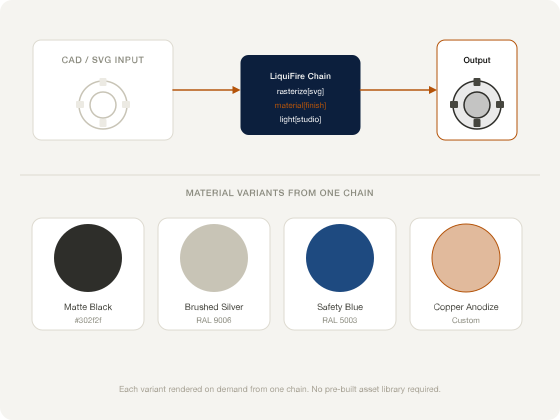
CAD tools produce dimensionally accurate geometry. They do not produce sellable images. LiquiFire OS takes SVG exports from your CAD environment, rasterizes them at output resolution, and applies material textures, surface finishes, and lighting inline. A brushed aluminum extrusion, a powder-coated enclosure, or a rubber-overmold grip, rendered accurately from the engineering file before a prototype exists.
Finish libraries are maintained as chain assets. When your surface treatment supplier changes a formulation or you qualify a new powder coat color, you update it once in the chain. Every product visual that references that finish updates across every catalog, configurator, and portal with no additional production work.
The real cost of a static asset library.
Two scenarios. Your numbers. See what you are actually spending.
Photorealistic renders before the first unit ships.
For manufacturers launching new products or entering new markets, the timeline between design approval and physical sample has always been a barrier to early-stage sales and marketing. LiquiFire Visual AI and LiquiFire 3D close that gap.
Studio-quality output from your CAD file
LiquiFire Visual AI takes SVG exports directly from your CAD environment and applies material, lighting, and environment rendering to produce studio-quality output. The geometry is preserved exactly: no artistic reinterpretation, no dimensional drift. Product portfolios can be published, configurators can be launched, and sales tools can be built before a single physical unit has been produced. For manufacturers managing large catalogs with hundreds of finish and configuration options, this eliminates the asset production bottleneck that typically delays go-to-market by weeks or months.
Configurators driven by your CPQ rules
LiquiFire 3D builds interactive configurators directly from your parametric product models. Every dimension, material, and assembly state is governed by the same configuration rules that live in your CPQ, not a parallel product database that someone has to keep in sync. A customer or dealer configuring a product interactively sees an accurate 3D representation at every step, and the configuration they finalize is the one that flows into the order.
Render the full catalog from your BOM
When a product line has tens of thousands of valid configuration states, a studio-based asset production model simply does not scale. LiquiFire Chains™ enumerate every valid combination from your BOM or CPQ rule structure and render the complete visual portfolio in a single automated operation. New finish options, revised dimensions, added accessories: the catalog updates when the product definition updates, with no manual intervention and no photography backlog.
Serialized and engraved output, rendered on demand.
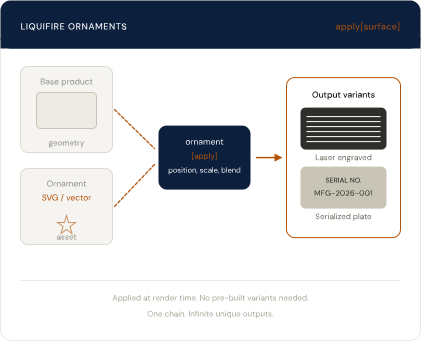
LiquiFire Ornaments applies complex surface decorations, including laser engraving patterns, embossed textures, etched regulatory markings, and dimensional surface motifs, to rendered product images in a single chain step. For manufacturers producing serialized, personalized, or compliance-marked components, this means every variant can be shown accurately without a separate studio session for each.
A customer-logo nameplate, a housing with a serialized part number, a component carrying a CE or UL marking: each can be rendered accurately from the same base geometry with the ornament applied at render time. For industrial equipment manufacturers, safety equipment producers, and anyone shipping into regulated markets, this eliminates a class of manual production work that previously had no scalable alternative.
Fits your infrastructure. No rebuild required.
Manufacturing IT environments range from cloud-forward to strictly on-premises. LiquiFire OS is available in the configuration that fits your infrastructure and your security requirements, with no compromise on capability.
Cloud-hosted
Fully managed, globally distributed rendering infrastructure. Connects to your ERP and PIM systems over secure HTTPS. The fastest path to production, with no servers to provision and no deployment project to manage.
On-premises appliance
A hardware or virtual appliance deployed inside your network perimeter. Rendering runs alongside your ERP and PLM systems. Product data and visual output stay within your environment. No external data egress. No cloud dependency.
Air-gapped and classified
A fully isolated deployment with no external network dependency of any kind. Appropriate for defense contractors, government-program manufacturers, and facilities operating under strict data classification or ITAR requirements.
Your product data is accurate. Your visuals should be too.
We work with manufacturers at every stage of this process, from scoping the integration architecture against your existing ERP and CPQ environment to deploying and tuning the chain layer in production. We work across complex industrial and manufacturing environments. If you are evaluating how to close the gap between your product data and your visual output, talk to us first.