Imaging-grade architecture, designed alongside your EA team.
Your Enterprise Architecture team owns your topology. LiquidPixels Solution Architects bring 25 years of imaging-workload expertise: sizing, throughput modeling, capacity planning across resolution ranges, configurator profiles, AI pipelines, and external-feed loads. Together, the topology is complete with real numbers rather than estimates. LiquiFire OS™ is a headless HTTP API, deployable wherever rendered output is required.
Current certifications and controls.
Certifications in force, audits in progress, and architectural controls that apply to every LiquiFire OS deployment. Detailed documentation is provided under NDA during security review.
Penetration test summaries and sub-processor lists are available under NDA during security review.
A joint practice with your Enterprise Architecture team.
Your EA team owns the topology. They know your standards, your vendor relationships, and how new infrastructure should integrate into the estate. LiquidPixels Solution Architects bring the imaging-domain expertise that turns a topology into a sized, validated deployment: throughput per LiquiFire Render Node™ at your image resolutions, capacity behavior under your LiquiFire Chains™, scenario modeling against your traffic profile.
The intended outcome is a deployment your architects, security team, and procurement group can stand behind on day one, sized against the actual imaging workload rather than a generic capacity estimate.
-
We listen before we propose
Your image source profile, target resolution range, chain types, concurrency patterns, and consumer systems all shape the deployment. Nothing about the sizing is speculative.
-
We respect the vendor path you already have
Our preference is to deliver on hardware we design and build ourselves. If your organization has existing datacenter hardware agreements with a specific OEM, our Architects work inside those relationships rather than around them. Your procurement path stays intact either way.
-
We plan for your business, not just the moment
Architecture decisions outlive a single project. We size for what you run today and leave the explicit upgrade path for where your company is heading.
-
We hand over what you can operate
The topology is documented in the terms your EA team uses. Runbooks, integration contracts, and acceptance criteria are produced as part of the work, so your operations team runs it from day one.
Sizing depends on the imaging workload, not on a generic node count.
A million 5-megapixel product-catalog renders per day is a different topology than ten thousand 200-megapixel scientific-imaging compositions, even though both might appear similar at first glance. LiquiFire OS deployments are sized against the actual image profile: source resolution, chain complexity, concurrency, AI-pipeline depth, configurator behavior, and external-feed load. Growth headroom is calculated, not estimated.
Sized for current production load.
Sizing starts with the actual imaging workload: source-asset profile, target resolutions, the LiquiFire Chains your team runs, and the systems that will consume rendered output. Capacity is sized to that workload's measured behavior, with headroom calibrated to its growth direction rather than to a worst-case estimate that inflates cost without reason.
The result is a deployment your operations team can run confidently from the first day, with observability and failure modes documented in the language they already use.
Designed to scale in place.
The growth direction is decided during design, not after the first capacity event. Additional LiquiFire Render Nodes, new datacenters, cloud offload for peak events, a move from the LiquiFire Hosted Service™ to dedicated instances: every one of these is a configuration change rather than a re-platform.
LiquiFire OS is the same engine across every footprint. The LiquiFire Chains do not change when the topology does.
From a hosted account to the world's largest rendering cluster.
LiquiFire OS is a single platform across the full operating range. The LiquiFire Hosted Service for multi-tenant SaaS access, an elastic license footprint inside your own cloud, a high-availability cluster across your datacenters, dedicated instances for specialized workloads, or a fully air-gapped LiquiFire Appliance™ as the Secure Edition. Movement along the range is by design: the same LiquiFire Chains, the same API, the same engine. Customers grow into larger deployments without re-platforming.
-
01
LiquiFire Hosted Service
Multi-tenant SaaS. Live in hours, no procurement cycle.
Hosted -
02
Cloud licenses
Elastic LiquiFire OS licenses inside your AWS, Azure, GCP, or private cloud. Scale capacity in minutes.
Customer cloud -
03
Multi-datacenter HA
Active-active topology with health-weighted routing and rolling zero-downtime upgrades.
High availability -
04
Dedicated instances
Isolated runtime for heavy 3D, web-to-print, AI pipelines, or mission-critical configurators.
Specialization -
05
LiquiFire Secure Edition™
Fully air-gapped appliance. Zero external connections, customer-operated, customer-owned hardware.
Air-gapped
Infrastructure-agnostic deployment.
LiquiFire OS deploys into existing enterprise infrastructure without requiring new operational standards. Topology is designed to align with current hosting posture, vendor relationships, and security policies.
LiquidPixels cloud
Managed hosting in LiquidPixels data centers. Fully operated by LiquidPixels, with capacity scaled to measured traffic rather than worst-case estimate.
- LiquidPixels-operated
- US and EU regions
- Monitoring and upgrades included
- SLA-backed availability
Your cloud
LiquiFire OS deployed into your AWS, Azure, GCP, or private cloud. Runs inside your VPC, under your security policies, billed on your cloud account. Elastic AWS AMI licenses let you scale render capacity up or down in minutes, paying only for what you actually run.
- Your account, your IAM, your keys
- Elastic, metered by instance time
- Your data stays in your cloud boundary
- Your observability stack
Dedicated hardware
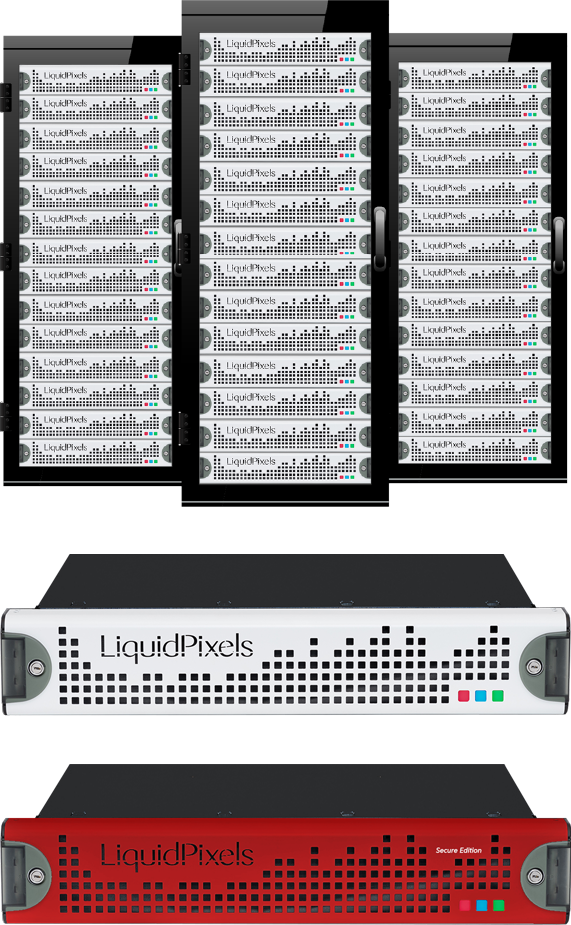
LiquidPixels designs and builds its own appliance hardware, tuned to the LiquiFire OS workload. This is the preferred delivery path. Where standing OEM agreements exist with enterprise hardware partners, LiquidPixels Architects work within those relationships and their on-site maintenance networks.
- Preferred: LiquidPixels-built, workload-tuned
- Alternative: your existing OEM vendors
- On-site setup, distribution, maintenance
- Lifecycle handled end to end
Hybrid
Your on-premise hardware and your cloud capacity working as a single routed fabric. Sensitive workloads stay inside your datacenter; public traffic is served from elastic cloud capacity.
- On-premise primary, cloud burst
- One chain language across both
- Route by sensitivity or geography
- CDN-native caching in front
Where Solution Architecture work typically begins.
Most projects begin from one of a small number of specific operational or strategic conditions. Each has an established architectural pattern, refined across prior deployments.
Cloud offload requirement
On-premise deployments facing peak events, new market launches, or unpredictable campaigns occasionally exceed steady-state capacity. Solution Architecture designs a cloud spillover path that holds baseline cost predictable without capping upside.
Proximity to production systems
Manufacturing lines, print facilities, and broadcast pipelines require rendering capacity adjacent to the physical operation. Topology is designed around that proximity constraint as a primary input, not a retrofit.
Multi-location retail operations
Retail chains requiring a local LiquiFire node in every store for offline resilience, low-latency configurators, or regional content rules. Centralized control plane, distributed execution, zero store-level administration.
Air-gapped operating environment
Security postures prohibiting outbound network calls, or environments under strict data residency requirements. LiquiFire Secure Edition is the corresponding deployment model, sized to the specific workload.
Platforms and ISVs. Organizations embedding LiquiFire OS rendering into their own software products follow a different engagement model. See Platforms & ISVs for that path.
Interactive topology designer.
Configure datacenters, LiquiFire Balancer Nodes™, and LiquiFire Render Nodes against a working model of a LiquiFire OS deployment. The designer exports live architecture diagrams to SVG, PNG, PDF, draw.io, Visio, and Miro formats, suitable as the starting artifact for the Solution Architecture conversation.
Discovery, design, delivery.
Every Solution Architecture project follows the same three phases. Duration varies with scope; the sequence does not.
Discovery and assessment
Working sessions with your EA, application, and operations teams to characterize the imaging workload: source-asset profile, target-resolution range, LiquiFire Chain types, concurrency patterns, consumer systems including configurators and external feeds, and the AI pipelines in scope. Infrastructure context, security posture, and vendor relationships are mapped alongside, but the imaging workload is the primary input.
Typically 2 to 3 weeks
Topology proposal
LiquidPixels Solution Architects produce a deployment topology covering sizing, failover behavior, integration contracts, and cost envelope. The proposal is reviewed and revised until the topology is one your organization can formally approve.
Typically 4 to 6 weeks
Implementation and handover
Implementation runs in coordination with your IT, security, and hardware vendors. The architecture is documented, validated against formal acceptance criteria, and transitioned to managed operation or enterprise support.
Typically 8 to 16 weeks, depending on footprint
The full scope of the work.
What you are buying is imaging-domain expertise applied to your workload, plus the running system that expertise produces: hardware, consumable spares, license capacity, and software elasticity, sized and supported together rather than assembled separately.
Hardware
The LiquiFire Balancer Node orchestrates the cluster, distributing load, handling edge caching, and accepting new LiquiFire Render Nodes as the cluster grows without reconfiguration. LiquiFire Storage Nodes™ hold the asset pool. Sized to steady-state load with measured headroom. LiquidPixels-built by preference; delivered through customer OEM partners where standing agreements apply.
Spare parts and spare appliances
Hot-swappable components kept on hand, with full spare appliances staged on-site or in regional LiquidPixels depots for rapid failover. Time-to-recovery is a design input, not a post-incident discovery.
Hot and cold licenses
Active licenses sized to steady-state traffic. Cold licenses held in reserve for seasonal surge, disaster recovery, or regional spin-up. Baseline cost reflects actual workload, not projected peak.
Software elasticity
Balancer, Render, and Storage tiers scale independently. Capacity expands where workload grows, not uniformly across the stack. No re-architecting required when traffic doubles, triples, or shifts shape.
Pricing is sized to the imaging workload during the Solution Architecture conversation, not published as fixed tiers or sold from prepaid credit pools. Overflow is invoiced rather than throttled. LiquidPixels Support actively helps customers optimize LiquiFire Chains, cache policies, and integration patterns to reduce ongoing cost. Seasonal volume patterns are accommodated in the commercial structure rather than penalized.
Available structures include the LiquiFire Hosted Service, managed cloud licenses, the LiquiFire Appliance, and the LiquiFire Secure Edition, each with optional extension packs and managed-operation overlays.
See commercial structureRequirements, dependencies, constraints.
What Solution Architecture work requires from your side, what the resulting design depends on, and the operational constraints the topology is designed within. Surfaced upfront because each materially shapes the deployment.
What we need from you
An Enterprise Architecture sponsor empowered to make decisions, a network architect contact, current infrastructure diagrams, a realistic traffic profile with peaks, and the SLAs your business commits to externally. Without these inputs, any proposed topology is speculative.
What the design depends on
Network paths to your asset sources, your identity provider for role-based access, monitoring endpoints your operations team already uses, and change-control windows your teams can honor during deployment. The topology is only as reliable as what sits around it.
What we operate inside
Your procurement cycle, your hardware vendor agreements, your compliance posture, your existing observability tooling, and your acceptance criteria. Each constraint shapes the design rather than blocks it. The topology is proposed in a form your teams can formally approve.
Bring your Enterprise Architecture team.
We will bring the topology.
An introductory session covers current infrastructure, operational constraints, and the business outcomes the architecture will support.